Night 4

Thursday, April 29, 2010 0 comments

 The last pages (from 81 - 109) really touched me. I almost cry on page 106, when Elie's father dies. It is a very sad death, considering all they went through, and the bond you created with the character through the story. I really liked Elie's father. He was a sweet, responsable and caring person, who sacrified for his son. And only 3 months before being liberated, he died. Not fair.

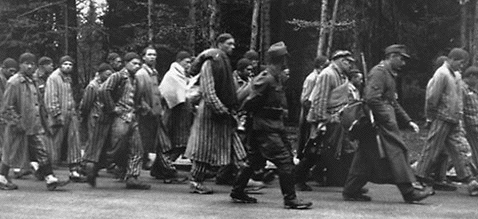
In these pages Elie describes how they changed camp and his experiences there, but most importantly: How they got there. Prisioners were forced to march - or actually - RUN for their lives for more than 40 miles on a freezing night! Hundreds died of cold, hunger or simply exhaustion. After that they arrived to a new camp: Glewitz. There they were thrown into a small room, all piled up, with no food, and little air. Many suffocated, or got crushed and died. After three days, the Nazis took them to another camp, but first they had to make another selection: Weak to the left, strong to the right. Elies was on the right side, but his father on the left one. Fortunately, Elie went running to the left side to create confussion and disorder, and the Gestapo took him back to the right side along with his father. They survived.

Later that day, they had to wait for a train that would take them to their last destination: Buchenwald. In the train they put one hundred Jews in a single wagon. When they arrived to the station, the dead stayed on the wagon and the alive survived. Elie's father stayed still in the wagon and wouldn't open his eyes, but just before the Gestapo threw his "corpse" Elie slapped him in the face, and he woke up. He beated death, again.


In Buchenwald Elie's father was extremely weak and depressed. He begged his son for mercy, to let him die, but Elie didn't allow it. After saving his dad from death several times, Elie took charge of him. He brought him part of his food, gave him water and affection. But one night, January 28, 1943, Elie's father got beaten up by an officer. He called was calling Elie to bring him water, and didn't listened the officer's orders to remain silent. After this, Elie went to sleep in the bunker rith above his father. Next morning, his father wasn't in his bunker anymore. The Gestapo took him (probably to the crematory) and maybe he wasn't even dead, just tired and weak. His last word was "Elie":

"I awoke on January 29 at dawn. In my father's place lay another invalid. They must have taken him away before dawn and carried him to the crematory. He may still have been breathing.                                                                                                                                                          There were no prayers at his grave. No candles were lit to his memory. His last word was my name. A summons, to which I did not respond"


Elie was transfered to the kid's block, and stayed in the camp until April. On April fifth, the Gestapo announced they were going to be freed by Hitler's commends. But after 6 days of nothing happening, no food at all, the resistance movement decided to attack the camp. On April eleventhat six o'clock, a U.S tank entered through the doors of the camp. They gave food and aid to the -now free- prisioners.

Three days after his liberation, Elie got sick from food poisoning and almost died. In the hospital he decided to look at himself in a mirror. He didn't recognize himself. He saw a skinny, weak, fragile boy. A boy that survived the world's worse situation. A boy that beated hunger, cold and loneliness. A boy he admired, in a strange way. A boy that will never leave his memory.

Night 3

From pages 45 - 80 they arrive tu Buna. The camp looked abandoned, and soon they bagan their labors. Some of the Kapos were nice with the prisioners, but the Gestapo officials were cruel. Idek, was the chief of Eli's section, and he was kind but sometimes he let all his anger explode and couldn't control himself. He once beated Elie's father for marching incorrectly, and Elie for beign in the room when he was with a Polish girl.

After that Yom Kippur came, and Jews were suppossed to feast, but it was very hard because they would be too weak. Soon came New Years, and a new  selection came. The Gestapo officials wrote the numbers of the people who were weak or old, and Elie's father was in there. Fortunately he passed the second selection and survived.


Days moved on, and towards the middle of January, Elie's foot began to hurt. He had to go to the hospital and had a surgery. While he was in  the hospital, the Red Army (Russians) were coming closer to Buna, so Germans had to evacuate and go somewhere else. They said that people in the hospitals was going to be left behind alive: "Tomorrow, inmediatly after nightfall, the cap will be set out. Block after block. Patients will stay in the infirmary. They will not be evacuated." pg. 77. Elie didn't believed this, and thought that all the patients would get killed: "All the invalids will be summarily killed" pg. 77

Because of his suspects, he decided to go outside (with his foot bleeding) and be evacuated with his father to another camp somewhere else in Germany. Later he found out that patients where actually left behind and rescued by the Red Army.

Night 2

Wednesday, April 28, 2010 0 comments


From pages 20 to 45 they are beign taken to Auschwitz in small wagon when all of the sudden a lady called Madame Schachter yelled "Fire" at the top of her lungs. Everyone complained about her and after it happened several times, they tied her up and beated her. When they got to the camp, they saw she the reason of her screams. The saw smoke and fire comming out a chimney. It was the crematory. If they didn't passed the "selection" of the fittest by the Nazis, they went there. If they didn't work hard enough, they went there. If they disobeyed, they went there. If they showed any humanity, they went there.


In Auschwitz his family split: His mother and sister went one way. Him and his father other. They were shaved, bathed, dressed and forced to work in brutal conditions. They changed barracks very often and had times of suffering, and times of "joy". In some they had beds, good sleep and enough food. In others they stayed in mud, eating few and sleeping less.


While beign in the camp, they discovered that they couldn't outstand from the people, because if they were too weak, they'll go to the crematory, and in the other hand, if they were too strong, they kept them until the end and made them work harder. After few weeks in Auschwitz, they were translated to a different camp: Buna.

Night 1


When I first opened this book I realized it is different from all the other holocaust books. It is an interesting, heart-breaking memoir of a survivor, who experienced all when he was just a boy. It is interesting how he tells the story from the very beggining of his youth, his faith in his religion and his thrist of knowlegde. In the first 20 pages he starts by introducing himself and his family. He also mentions an important character: Moshe the Beadle. Moshe was a homeless man who lived in his neighborhood in Transylvania, who was really spiritual and helped Eli with his studies. Eliezer says that at the beginning Jews were very optimistic about the Holocaust, and though it would affect them so much. After Moshe was taken by the Germans and escaped, he told people the true about the Nazis and the risk they were exposed to, but no one listened. After some months, they were surrounded by fences creating a ghetto around their houses. After this, everything got worse. They were taken to concentration camps in small wagons (with 80 people inside!) and in the blink of an eye, they became war prisioners.

Sodom and Gomorrah: Eviction Notice

Sunday, April 25, 2010 0 comments

Citizens of Sodom:

We are angels sent by God to this town with only one purpose: It's destruction.

As you may know, only the good people deserve salvation. Because of this, only Lot and his family (wife, daughters, sons-in-law) will be allowed to leave this place before its ending.

The rest of you will stay and die along with Sodom, because the protests against it an its citizens were so loud, they reached the Lord, who ordered its destruction.

The eviction will take place tomorrow morning and has only one condition: Do not look back.
If anyone disobeys, he or she will receive punishment from the Lord.