FIFA World Cup 2010 Concert! (revised)

Wednesday, May 26, 2010 0 comments

On June 11 of 2010 people throughout the world will experience an amazing combination of my two biggest passions: Soccer and music!

The Kick-off Celebration Concert will be held the night before the official start of the cup on the Orlando Stadium, Johannesburg at 8:00 p.m. It will count with great national and international performers, as well as several legendary soccer players.

It also makes me really proud to inform that 2 out of the 12 artists are colombian! Yes, I'm talking about Shakira and Juanes, who will share the stage with 10 other amazing bands:

Alicia Keys
Amadou & Mariam
Angelique Kidjo
Black Eyed Peas
BLK JKS
John Legend
The Parlotones
Tinariwen
Vieux Farka Touré
Vusi Mahlasela 

This is a great oppurtunity for both Colombian artists to gain more international recognition (as Shakira did in 2006's Germany World Cup when being chosen to interpret the cup's official song Hips Don't Lie Bamboo) and to help others benefit from their music, as they are worldwide recognized for their humanitarian work: Shakira's "Pies Descalzos" foundation which helps low resource kids in Colombia, and Juanes' "Mi Sangre" foundation which helps victims of the anti-personnel mines.


The concert will be organizd by Kevin Wall (Emmy winner producer) and his company "Control Room". These had also participated in the world's biggest concert "Live Earth", 2007 which counted with the participation of 150 performers on all the continents through 24 hours.

When asked about the Kick-off Celebration Concert, Wall said:
“We believe sports and music transcend cultural, language and geographic barriers, and through the official FIFA World Cup Kick–off Celebration Concert, Control Room will present the sights and sounds of unity and celebration for an unforgettable, must-see experience,”


 And offcourse this concert has a good purpose. It is a fund-raising concert to help the "20 Centres for 2010" campaign, which intends to build 20 helthcare, education and soccer centers across Africa. The centers will be focused in helping Africa's most disadvantaged communities exceed their major social problems through soccer:
"The creation of a Football for Hope Centre begins with identifying both the local challenges as well as a local organization that successfully uses football-based programs for social development. The centre and the programs that are run there, e.g. HIV/Aids awareness, literacy, gender equality, disability and integration, are created to meet the needs of the community."
I am looking foward for this event and the cup itself.  Only 14 days to go...

Video: http://www.fifa.com/worldcup/organisation/concert/index.html

Aphorisms revised

Tuesday, May 11, 2010 0 comments

1. Honesty and appropiate-timing are the best ways to avoid punishment.
2. The truth can always be told in a nicer, more sensible, less-dramatic way to others.
3. Express your feelings through a smile: love, pain, regret, etc... because it will always end up cheering you up.
4. Some use their brains. Some use their looks. But the best way to win someone's heart is by smiling.
5. Uniqueness is so varied, everyone in the world has it in their own way.
6.Shout, run, jump, laugh and cry as long as you do it because you feel to.
7. The desperate search for uniqueness is so common.
8. He who critizes the first, thinks the least.
9. Brave ones aren't heroes. They just relize the risks last.
10.  Success in not measured by the amount of money in your pockets. Success is being capable to look back into your life and have no problem with what you see.

*I changed some words to make fit the maxium's style

MY aphorisms!

Wednesday, May 5, 2010 0 comments

1. Honesty and goog-timing are the best ways to avoid punishment.
2. The truth can always be told in a nicer, prettier, less-dramatic way to others.
3. Express every feeling through a smile. Love, pain, regret, etc... because it will always end up cheering you up.
4. Some use their brains. Some use their looks. But the best way to win someone's heart is by smiling.
5. Uniqueness is so varied, everyone in the world has it in their own way.
6.Shout, run, jump, laugh and cry. As long as you do it because you feel to, is okay.
7. The desperate search for uniqueness is so common.
8. He who critizes the first, thinks the least.
9. Brave ones aren't heroes. They just understand the risks last.
10.  Success in not measured by the amount of money in your pockets. Success is being capable to look back into your life and have no problem with what you see.

Maus vs. Night

Tuesday, May 4, 2010 0 comments

Both are very interesting and exciting books, that basically tell a similar story, but with different points of view. Both authors talk about the Holocaust, one from his own point of view (because he went through it) and the other by the father's experience.


In Maus the story is told by Art Spiegelman about how his father (Vladimik Spiegelman) had to escape the people who chased him down in Poland. He was a wealthy man, who could afford payind for hidding places and favors. He remained hidden for a long time, but unfortunately, he was sent to a camp at the end. The book uses the animal metaphor, in which rats are Jews, cats are Germans, Poles are pigs, and U.S citizens were dogs. This is a perfect metaphor because dogs chase cats, who at the same time chase rats. Pigs are the only neutral animals. Maus part I mainly talk about what Vladimik did to avoid camp, and everything him and his wife went through when they were hidden. They don't talk about his life in the camp at all.


Night, on the other hand, is a memoir told by Elie Weisel who was tajen from Transylvania, Hungary. In Hungary things were way better than in Poland. Jews were taken almost at the end of the Holocaust, and even though people from Elie's town were warned about the dangers of staying, they didn't cared. But sooner or later, the day when the Germans inveded them came, and they took Elie and his family when he was just a boy. His family was split and he went to a camp with his father. Most of this story tells their experiences in the camp, all the inhuman conditions they went through and how they changed every day that went by. Elie endures all the Holcaust, but his father died three month before being liberated. His mother and sister also died, but the book doesn't specify how.

Night 4

Thursday, April 29, 2010 0 comments

 The last pages (from 81 - 109) really touched me. I almost cry on page 106, when Elie's father dies. It is a very sad death, considering all they went through, and the bond you created with the character through the story. I really liked Elie's father. He was a sweet, responsable and caring person, who sacrified for his son. And only 3 months before being liberated, he died. Not fair.

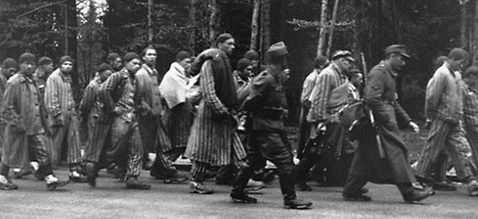
In these pages Elie describes how they changed camp and his experiences there, but most importantly: How they got there. Prisioners were forced to march - or actually - RUN for their lives for more than 40 miles on a freezing night! Hundreds died of cold, hunger or simply exhaustion. After that they arrived to a new camp: Glewitz. There they were thrown into a small room, all piled up, with no food, and little air. Many suffocated, or got crushed and died. After three days, the Nazis took them to another camp, but first they had to make another selection: Weak to the left, strong to the right. Elies was on the right side, but his father on the left one. Fortunately, Elie went running to the left side to create confussion and disorder, and the Gestapo took him back to the right side along with his father. They survived.

Later that day, they had to wait for a train that would take them to their last destination: Buchenwald. In the train they put one hundred Jews in a single wagon. When they arrived to the station, the dead stayed on the wagon and the alive survived. Elie's father stayed still in the wagon and wouldn't open his eyes, but just before the Gestapo threw his "corpse" Elie slapped him in the face, and he woke up. He beated death, again.


In Buchenwald Elie's father was extremely weak and depressed. He begged his son for mercy, to let him die, but Elie didn't allow it. After saving his dad from death several times, Elie took charge of him. He brought him part of his food, gave him water and affection. But one night, January 28, 1943, Elie's father got beaten up by an officer. He called was calling Elie to bring him water, and didn't listened the officer's orders to remain silent. After this, Elie went to sleep in the bunker rith above his father. Next morning, his father wasn't in his bunker anymore. The Gestapo took him (probably to the crematory) and maybe he wasn't even dead, just tired and weak. His last word was "Elie":

"I awoke on January 29 at dawn. In my father's place lay another invalid. They must have taken him away before dawn and carried him to the crematory. He may still have been breathing.                                                                                                                                                          There were no prayers at his grave. No candles were lit to his memory. His last word was my name. A summons, to which I did not respond"


Elie was transfered to the kid's block, and stayed in the camp until April. On April fifth, the Gestapo announced they were going to be freed by Hitler's commends. But after 6 days of nothing happening, no food at all, the resistance movement decided to attack the camp. On April eleventhat six o'clock, a U.S tank entered through the doors of the camp. They gave food and aid to the -now free- prisioners.

Three days after his liberation, Elie got sick from food poisoning and almost died. In the hospital he decided to look at himself in a mirror. He didn't recognize himself. He saw a skinny, weak, fragile boy. A boy that survived the world's worse situation. A boy that beated hunger, cold and loneliness. A boy he admired, in a strange way. A boy that will never leave his memory.

Night 3

From pages 45 - 80 they arrive tu Buna. The camp looked abandoned, and soon they bagan their labors. Some of the Kapos were nice with the prisioners, but the Gestapo officials were cruel. Idek, was the chief of Eli's section, and he was kind but sometimes he let all his anger explode and couldn't control himself. He once beated Elie's father for marching incorrectly, and Elie for beign in the room when he was with a Polish girl.

After that Yom Kippur came, and Jews were suppossed to feast, but it was very hard because they would be too weak. Soon came New Years, and a new  selection came. The Gestapo officials wrote the numbers of the people who were weak or old, and Elie's father was in there. Fortunately he passed the second selection and survived.


Days moved on, and towards the middle of January, Elie's foot began to hurt. He had to go to the hospital and had a surgery. While he was in  the hospital, the Red Army (Russians) were coming closer to Buna, so Germans had to evacuate and go somewhere else. They said that people in the hospitals was going to be left behind alive: "Tomorrow, inmediatly after nightfall, the cap will be set out. Block after block. Patients will stay in the infirmary. They will not be evacuated." pg. 77. Elie didn't believed this, and thought that all the patients would get killed: "All the invalids will be summarily killed" pg. 77

Because of his suspects, he decided to go outside (with his foot bleeding) and be evacuated with his father to another camp somewhere else in Germany. Later he found out that patients where actually left behind and rescued by the Red Army.

Night 2

Wednesday, April 28, 2010 0 comments


From pages 20 to 45 they are beign taken to Auschwitz in small wagon when all of the sudden a lady called Madame Schachter yelled "Fire" at the top of her lungs. Everyone complained about her and after it happened several times, they tied her up and beated her. When they got to the camp, they saw she the reason of her screams. The saw smoke and fire comming out a chimney. It was the crematory. If they didn't passed the "selection" of the fittest by the Nazis, they went there. If they didn't work hard enough, they went there. If they disobeyed, they went there. If they showed any humanity, they went there.


In Auschwitz his family split: His mother and sister went one way. Him and his father other. They were shaved, bathed, dressed and forced to work in brutal conditions. They changed barracks very often and had times of suffering, and times of "joy". In some they had beds, good sleep and enough food. In others they stayed in mud, eating few and sleeping less.


While beign in the camp, they discovered that they couldn't outstand from the people, because if they were too weak, they'll go to the crematory, and in the other hand, if they were too strong, they kept them until the end and made them work harder. After few weeks in Auschwitz, they were translated to a different camp: Buna.